Miami Oral Myofunctional Therapy
Written by the Real Smile Dentistry team. Medically reviewed by Dr. Hamid Nassery, DMD, FICOI, FAGD, FICCMO. Last reviewed: August 2026.
Better breathing. Better smiles.
A functional foundation
for better health
Oral myofunctional therapy is a program of guided exercises that retrains the tongue, lips, cheeks, and facial muscles to rest, swallow, and breathe the way they are built to. At Real Smile Dentistry, Miami oral myofunctional therapy sits inside our airway-focused care, so we look at muscle habits and breathing together instead of treating either one on its own.
Most people find their way to us after something else stopped adding up. Teeth that drifted back after braces. A tongue-tie release that helped less than expected. Snoring that no one could account for. Habit is often the piece underneath, and habits respond to training rather than hardware.
The same principles hold whether we are working with a seven-year-old or a sixty-year-old, which is why this work sits alongside the rest of our care for the whole family.
What does myofunctional therapy treat?
Muscle retraining addresses mouth breathing, tongue thrust, disordered swallowing, clenching, and relapse after orthodontics, along with the feeding trouble that can follow a tongue- or lip-tie. Those patterns look unrelated on the surface. Underneath, they share a cause: muscles doing a job in a way the body has adapted to but never corrected.
Patterns we see most often in our patients:
- Mouth breathing or snoring: the tongue rests low, the lips stay apart, and nasal breathing never becomes the default.
- Tongue thrust or open bite: the tongue pushes forward during a swallow, and the front teeth slowly follow it.
- Clenching, grinding, or jaw tension: overworked muscles hold tension through the night and into the morning.
- Speech and posture concerns: tongue position affects how sounds form and how the head sits over the shoulders.
- Feeding difficulty in infants: a restricted or poorly coordinated tongue makes latching and transferring milk harder.
- Relapse after orthodontics: teeth move back toward the pressure that put them out of line the first time.
Jaw tension and headaches frequently travel with these patterns, so an evaluation here sometimes points toward TMJ treatment as well.
How we evaluate oral muscle function
before any exercise begins
We measure what your muscles, joints, and airway are doing before we assign a single exercise, using the same physiologic diagnostics we rely on for jaw and airway cases at our Miami Beach and North Miami offices.
Our CT scanner shows us the head, mouth, throat, neck, bite, and airway size in three dimensions, which tells us whether a low tongue posture is a habit, a restriction, or a response to a narrow airway. Jaw tracking records how the jaw actually moves through its range. EMG scanning reads muscle tension at rest and under load. T-Scan computerized bite analysis maps where and when your teeth meet, down to timing most people never notice.
Those four readings change what the program looks like. A tongue that cannot lift because of a restriction needs a different plan than a tongue that can lift but has never learned to stay there. If you have not been in before, your first visit with us starts with that same groundwork.
What to Expect
- Initial assessment: we evaluate muscle function, airway, posture, and oral habits to build a full picture before anything is prescribed.
- Personalized plan: your therapist designs a program of exercises built around your findings, your age, and what you are trying to change.
- Ongoing support: we meet on a regular schedule to check progress, adjust the plan, and keep you going while new muscle memory sets in.
- Integrated care: if surgery, aligner therapy, or airway treatment is part of your care, we sequence everything so the pieces support each other.
How this pairs with tongue-tie release and airway care
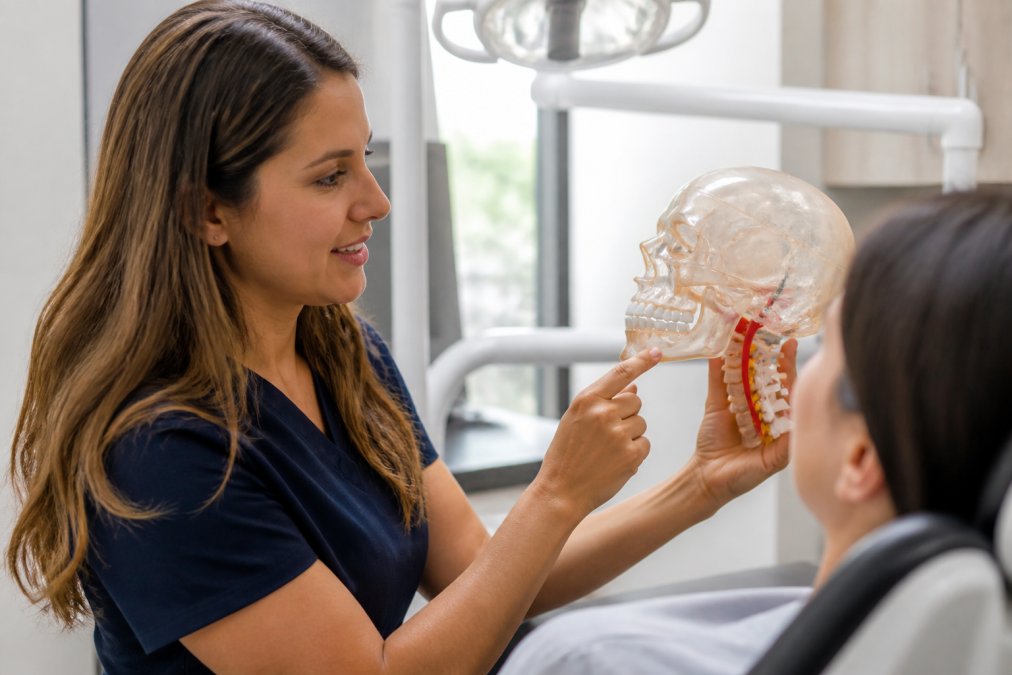
We do not release a tongue- or lip-tie without pairing it with muscle retraining, because a release changes what the tongue is able to do without changing what it is used to doing. Left alone, the old pattern usually reasserts itself and the result fades.
When a release is warranted, we perform it with our Fotona laser, and we treat patients of every age. The exercises begin around the procedure so healing tissue and new habits develop together rather than in sequence.
The same logic applies on the breathing side. Retraining the tongue and lips supports the work we do in airway and breathing care, where nasal breathing and tongue posture carry real weight.
FAQs
What does Miami oral myofunctional therapy involve?
Who is a good candidate?
How long does a program take?
What does it cost?
Will my insurance help cover it?
Is it uncomfortable, and what is the daily commitment?
Why choose us
for myofunctional therapy?
Physiologic Approach
We understand how muscles, bite, airway, and posture are connected, and we treat them as one system.
Integrated Frenectomy Care
We never perform tie releases without muscle retraining to support healing and long-term success.
Whole-Family Support
We work with children, teens, and adults to build lifelong habits for better sleep, speech, and health.
Collaborative, Compassionate Team
We partner with specialists and always listen to your needs, goals, and concerns.

Stories Worth Sharing
Transform your smile and your life
We have helped thousands of patients improve their well-being. Make an appointment today!
Our South Florida dental offices
Miami Beach
757 Arthur Godfrey Road
Miami Beach, FL 33140
Monday-Friday
8:30am-5:30pm
Click to call:
North Miami
1811 NE 123rd Street
North Miami, FL 33181
Monday-Friday
8:30am-5:30pm
Click to call:
Hollywood
4000 Sheridan St, Ste D
Hollywood, FL 33021
Wednesday: 8:30am-12:30pm
Click to call:

International Congress of Oral Implantologists (ICOI)

Academy of General Dentistry (AGD)
International College of Craniomandibular Orthopedics (ICCMO)