

Table of Contents
- Common Signs of Airway Issues in Children
- Mouth Breathing in Children: A Key Warning Sign
- Sleep-Related Indicators: Snoring, Restlessness, and Bedwetting
- Pediatric Sleep Apnea Symptoms and Sleep-Disordered Breathing
- Impact on Facial Development, Jaw Growth, and Dental Alignment
- When to See an ENT or Specialist for Child Breathing Problems
- Home Observation Checklist: Tracking Airway Health at Home
- How Airway-Centered Dental Care Addresses Root Causes
Last Updated: August 3, 2026
Recognizing signs of airway issues in children is one of the most overlooked aspects of pediatric health. Parents often miss critical warning signals because they assume mouth breathing, snoring, or restless sleep are simply normal childhood behaviors. Real Smile Dentistry has seen firsthand how early detection of airway problems can prevent serious complications with facial development, sleep quality, and academic performance.
Common Signs of Airway Issues in Children
Detecting airway problems early requires parents to understand what healthy breathing looks like versus what signals an underlying obstruction.
Daytime breathing patterns and noisy breathing
Children with healthy airways breathe quietly through the nose during the day. Persistent audible breathing sounds, wheezing, or stridor (high-pitched, musical breathing) suggest narrowing or obstruction in the respiratory tract. Chronic daytime mouth breathing often indicates nasal obstruction from enlarged adenoids, congestion, or structural issues like a deviated septum. Shortness of breath during normal play is a red flag.
Watch your child during a typical day. Does the mouth hang open while watching television or doing homework? Does breathing sound like snoring even when awake? Early intervention can prevent long-term complications.
Behavioral changes and attention difficulties
Chronic airway obstruction disrupts sleep quality, which directly impacts daytime behavior and cognition. A child with undiagnosed airway issues often exhibits attention deficit-like symptoms, hyperactivity, or irritability because sleep deprivation affects the developing brain. Teachers frequently report that children with airway problems struggle to focus, seem restless, or have difficulty following instructions. These behavioral shifts often improve dramatically once airway obstruction is treated.
Mouth Breathing in Children: A Key Warning Sign
Mouth breathing is perhaps the single most important indicator that something is wrong with your child’s airway. Unlike occasional mouth breathing during a cold, chronic mouth breathing signals that nasal passages are not providing adequate airflow.
Why nasal breathing matters for growth and development
Nasal breathing is essential for proper facial development. When a child breathes through the nose, the tongue rests in the correct position on the palate, which guides jaw growth and dental alignment. The nasal passages also warm, humidify, and filter incoming air before it reaches the lungs.
Children who mouth-breathe chronically develop "adenoid facies": a characteristic long face, narrow palate, and crowded teeth. The constant downward pull of the jaw during mouth breathing alters the growth trajectory of facial bones, leading to malocclusion, crowded teeth, and a narrow airway that perpetuates the original problem. Research from American Association of Orthodontists shows that early intervention to restore nasal breathing can guide jaw development in a more favorable direction, potentially reducing or eliminating the need for extensive orthodontic treatment later.
Distinguishing temporary congestion from chronic mouth breathing
A child with a head cold or seasonal allergies may mouth-breathe for a few days or weeks; this is temporary and normal. If your child has been mouth-breathing for more than a month, continues it even when not congested, or does it primarily during sleep, this suggests a structural or chronic issue. Adenoid enlargement is the most common cause of chronic mouth breathing in children.
Do not assume mouth breathing will resolve as your child grows. Chronic mouth breathing during childhood often becomes a habit that persists into adulthood, and the facial changes that occur during growth are largely irreversible. Early intervention is critical.
Sleep-Related Indicators: Snoring, Restlessness, and Bedwetting
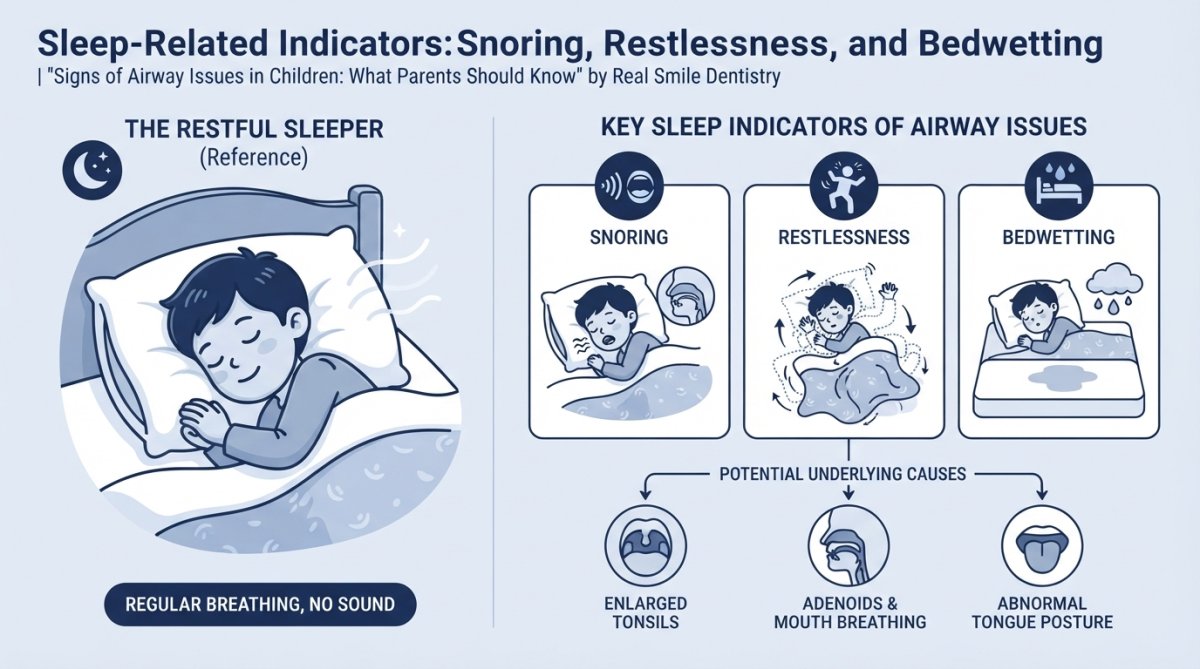
Sleep provides the clearest window into airway obstruction. When a child’s airway is partially blocked, the body works harder to move air through the narrowed space, producing sound and disrupting sleep architecture.
What snoring and restless sleep reveal about airway obstruction
Snoring in children is never normal. Unlike adults, where occasional snoring may be benign, pediatric snoring almost always indicates some degree of airway obstruction. Restless sleep is equally telling. A child with airway obstruction experiences frequent arousals (brief awakenings) as the brain tries to protect the airway. These arousals fragment sleep architecture and prevent restorative deep sleep. Parents observe this as tossing and turning, frequent position changes, or multiple nighttime awakenings.
Dark circles, daytime fatigue, and secondary bedwetting
Dark circles under the eyes are a hallmark of sleep deprivation in children. If your child consistently has dark circles, the sleep they’re getting is not restorative, even if they’re in bed for 8-10 hours. Daytime fatigue manifests differently in children than adults, a sleep-deprived child often becomes hyperactive, irritable, or emotionally unstable rather than appearing sleepy.
Secondary bedwetting, when a child who was previously dry begins wetting the bed, can signal sleep-disordered breathing. The disrupted sleep and stress on the nervous system from oxygen fluctuations during the night can trigger bedwetting even in older children.
Pediatric Sleep Apnea Symptoms and Sleep-Disordered Breathing
Sleep-disordered breathing exists on a spectrum, from simple snoring to obstructive sleep apnea (OSA). Understanding where your child falls on this spectrum helps determine urgency and treatment options.
Recognizing obstructive sleep apnea in children
Obstructive sleep apnea occurs when the airway collapses completely during sleep, stopping airflow for 10 seconds or longer. During these apnea events, oxygen saturation drops, and the brain triggers an arousal to restore breathing. In children, OSA symptoms include gasping or choking sounds during sleep, witnessed breathing pauses, and excessive daytime sleepiness. Some children also display behavioral problems, poor school performance, or ADHD-like symptoms that improve dramatically once OSA is treated. According to American Academy of Pediatrics sleep guidance, pediatric sleep apnea is underdiagnosed, with many children receiving ADHD diagnoses when the underlying cause is actually untreated sleep-disordered breathing.
How tonsillar hypertrophy and adenoid enlargement affect breathing
Enlarged tonsils and adenoids are the most common structural causes of airway obstruction in children. When these lymphoid tissues enlarge significantly, they narrow the airway and obstruct airflow during sleep. The degree of enlargement doesn’t always correlate with symptom severity, because individual airway anatomy varies. Chronic infections or allergic inflammation can perpetuate adenoid and tonsillar enlargement.
Tonsillar hypertrophy and adenoid enlargement are structural issues that often require intervention beyond watchful waiting. Early evaluation by an ENT specialist can determine whether the enlargement is contributing to clinically significant airway obstruction.
Impact on Facial Development, Jaw Growth, and Dental Alignment
One of the most significant long-term consequences of chronic airway obstruction is its effect on facial growth. The developing face responds to the forces and pressures exerted on it during childhood. Chronic mouth breathing and airway obstruction create abnormal growth patterns that become fixed as the child matures.
Long-term effects of chronic airway obstruction on facial structure
A child who mouth-breathes chronically develops a distinctive facial pattern: a narrow, high-arched palate; an underdeveloped or posteriorly positioned maxilla (upper jaw); and a recessed mandible (lower jaw). The face appears longer and narrower than it would have with normal nasal breathing and proper tongue posture. These changes have functional consequences. A narrow palate means less space for teeth, leading to crowding. A recessed mandible can contribute to sleep apnea risk later in life. The critical window for intervention is roughly ages 3-12, when facial development is most active.
Malocclusion, crowded teeth, and the role of myofunctional therapy
Malocclusion, misalignment of the teeth and jaws, is a common consequence of chronic airway obstruction. The constant downward pull of the jaw during mouth breathing, combined with abnormal tongue posture, creates forces that push teeth into misalignment. Myofunctional therapy retrains the muscles and habits that affect facial structure and airway. A myofunctional therapist teaches the child to breathe through the nose, position the tongue correctly, and swallow properly.
At Real Smile Dentistry, we integrate myofunctional therapy with our early interventional orthopedics program. By addressing airway issues and muscle function early, we help children develop their full growth potential and establish a healthy airway foundation for life.
When to See an ENT or Specialist for Child Breathing Problems
Knowing when to seek professional evaluation is crucial. While not every instance of snoring or mouth breathing requires immediate intervention, certain signs warrant prompt assessment.
Red flags that warrant immediate evaluation
Schedule an evaluation with your pediatrician or an ENT specialist if your child exhibits any of the following: witnessed apnea events (breathing stops for 10+ seconds), severe snoring that disrupts sleep or occurs nightly, gasping or choking sounds during sleep, extreme daytime fatigue or hyperactivity that affects school or social function, failure to thrive or poor growth, behavioral or learning problems that don’t respond to other interventions, mouth breathing that persists despite absence of congestion, or recurrent ear infections or chronic sinusitis.
Age-specific milestones and airway health checkpoints
Infants should breathe exclusively through the nose; mouth breathing in an infant is abnormal and warrants immediate evaluation. Toddlers and preschoolers (ages 2-5) should have minimal snoring and should primarily breathe through the nose during waking hours. School-age children (ages 6-12) are at peak risk for adenoid hypertrophy and sleep-disordered breathing. This is the optimal window for intervention, because facial growth is still actively occurring and can be favorably influenced by restoring nasal breathing and proper airway function.

Home Observation Checklist: Tracking Airway Health at Home
Before scheduling a specialist appointment, gather specific observations about your child’s breathing and sleep patterns. Detailed notes help your pediatrician or ENT specialist make an accurate assessment.
Daily observations parents can make without special tools
Use this checklist to document your observations over a 1-2 week period:
- Daytime breathing: Does your child breathe through the mouth when at rest? How often? Is breathing audible or silent?
- Activity tolerance: Can your child play actively without becoming unusually fatigued or short of breath?
- Sleep position: Does your child sleep in a typical position or assume unusual positions (extended neck, propped up)?
- Sleep sounds: Do you hear snoring, gasping, or other unusual sounds during sleep?
- Sleep restlessness: Does your child toss and turn, kick, or change positions frequently?
- Morning symptoms: Does your child wake with a dry mouth, complain of a sore throat, or seem groggy?
- Daytime symptoms: Dark circles, irritability, hyperactivity, or difficulty concentrating?
- Behavioral changes: Mood swings, anxiety, or unusual aggression?
- Bedwetting: Any bedwetting episodes, especially if this is new?
| Observation | Frequency | Notes |
|---|---|---|
| Mouth breathing during day | Daily / Several times weekly / Occasionally | Occurs at rest or only during activity? |
| Snoring during sleep | Every night / Most nights / Occasionally | Loud or quiet? Consistent throughout night? |
| Witnessed apnea or gasping | Yes / No | How many times per night? Duration? |
| Daytime fatigue or hyperactivity | Severe / Moderate / Mild / None | When is it worst? |
| Dark circles under eyes | Present / Absent | How long have they been present? |
| Difficulty concentrating | Yes / No | Affects school performance? |
| Secondary bedwetting | Yes / No | How frequently? Recent onset? |
When to document symptoms and share findings with your pediatrician
Document observations for at least 7-10 days before your pediatrician visit. This gives you a representative sample and helps you communicate patterns rather than isolated incidents. Bring your notes to the appointment and share them with your pediatrician. If you notice any red flags, particularly witnessed apnea events, severe snoring, or extreme daytime symptoms, contact your pediatrician promptly.
How Airway-Centered Dental Care Addresses Root Causes
Traditional dental care often treats symptoms without addressing underlying airway issues. A child with crowded teeth receives braces. A child with a narrow palate is referred for extraction. But if the root cause, airway obstruction and abnormal growth patterns, isn’t addressed, the problem often returns.
The connection between airway obstruction and orthodontic needs
Airway obstruction is a primary driver of malocclusion. When a child mouth-breathes chronically, the tongue doesn’t rest in the correct position on the palate. This removes the natural pressure that guides palatal development and dental alignment. Many children who receive orthodontic treatment without addressing their underlying airway issues experience relapse, as the teeth shift back toward their original misaligned positions after braces are removed.
Airway-centered dental care takes a different approach. By identifying and treating airway issues early, we prevent the malocclusion from developing in the first place and guide facial growth in an optimal direction.
Early intervention and growth guidance for developing airways
Real Smile Dentistry’s early interventional orthopedics program is designed specifically for children with developing airways. Using advanced diagnostic tools like CT scans and intraoral scanners, we assess airway anatomy, identify areas of obstruction, and create a personalized growth guidance plan. Growth guidance involves using gentle, consistent pressure to guide the developing jaws in a more optimal direction. Unlike traditional braces, which are typically applied after growth is complete, growth guidance works with the child’s natural growth process to achieve better outcomes. This approach is particularly effective for children with adenoid hypertrophy, narrow palates, or early signs of malocclusion.
If you’ve noticed any of the signs of airway issues in children we’ve covered, persistent mouth breathing, snoring, restless sleep, or behavioral changes, your child deserves a comprehensive airway evaluation. Real Smile Dentistry specializes in identifying and treating airway obstruction in children through early interventional orthopedics, growth guidance, and myofunctional therapy. Our team uses advanced technology including CT scans and intraoral scanners to develop personalized treatment plans that address root causes rather than symptoms. Early intervention during the critical growth years can prevent years of orthodontic complications and establish your child’s healthy airway for life. Book Now to schedule your child’s airway assessment and discover how airway-centered care can transform their health and development.
Frequently Asked Questions
How can I tell if my child has airway issues or just a temporary cold?
Temporary congestion from a cold typically clears within 7-10 days and is often accompanied by other cold symptoms like cough or fever. Chronic airway issues persist for weeks or months, showing consistent mouth breathing, snoring, or daytime fatigue even when your child isn't sick. If symptoms continue after congestion resolves, or if your child mouth-breathes year-round, consult your pediatrician to rule out structural problems like adenoid enlargement or nasal obstruction.
What are the signs of pediatric sleep apnea symptoms I should watch for?
Pediatric sleep apnea symptoms include loud snoring, pauses in breathing during sleep, gasping or choking sounds, restless sleep with frequent waking, and excessive daytime sleepiness. Children may also experience dark circles under the eyes, behavioral problems at school, difficulty concentrating, or secondary bedwetting. If your child shows these patterns, especially snoring combined with daytime fatigue, mention them to your pediatrician or sleep specialist.
When should I take my child to see an ENT specialist for breathing problems?
See an ENT specialist if your child has chronic mouth breathing lasting more than a few weeks, persistent snoring, sleep-disordered breathing, noisy breathing at rest, or significant daytime fatigue. Also seek evaluation if your child has recurrent ear infections, chronic nasal congestion, or if you notice changes in facial structure or jaw growth. Early evaluation can prevent long-term effects on development and dental alignment.
Can untreated airway issues affect my child's teeth and jaw development?
Yes. Chronic airway obstruction forces children to mouth-breathe, which alters tongue position and facial muscle function. This can lead to malocclusion (misaligned bite), crowded teeth, and changes in jaw growth. The face may develop a longer, narrower shape. Early intervention through airway-centered dental care and myofunctional therapy can guide proper growth and prevent or reduce the need for extensive orthodontic treatment later. Addressing airway issues early sets children up for healthier facial development and better long-term outcomes.
This article was written using GrandRanker